
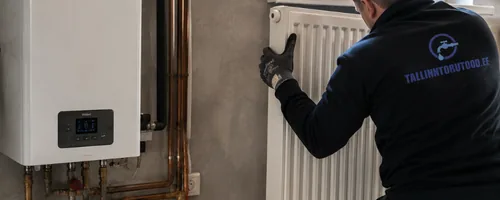
#1 plumbing company in Tallinn
Water heater element replacement in Tallinn
Tallinn Torutööd replaces the water heater element in apartments and detached houses in Tallinn and Harju County. This repair is part of the water heater installation and maintenance: lukewarm water and a blown fuse indicate a heating element buried under scale, not a failure of the entire device.
Tallinn Torutööd replaces heating elements on Thermex, Ariston, Gorenje and Dražice boilers, which is why the correct flange size and seal type is already known after a phone call.
- Open every day
- Licensed and insured
- 100% satisfaction guarantee
- Heating element replacement takes 45 minutes
Request a quote for planned work
When a heating element needs replacing
Water heats slowly or stays lukewarm
The clearest sign is water that no longer gets hot in the same position of the thermostat. A full 2,000 watt heater heats a 100 liter tank from 10 degrees to 65 degrees in 3 hours and 12 minutes, so the lukewarm water in the morning from the boiler turned on at night means the element is no longer working at full capacity.
The residual current device trips
Residual current protection tripping immediately after the boiler is switched on means that the insulation of the heating element has broken and current is escaping into the water. Measured with a multimeter, a healthy 2000 watt cell has a resistance of 26 ohms, a blown cell has an infinite resistance.
Hissing or crackling from the tank
The hissing and crackling means that the water is boiling off locally under the scale layer. a water heater with an intact tank stays on the wall and only the heating element with the gasket comes out.
Why Scale Accumulates on the heating element
The bedrock of Northern Estonia is limestone, and tap water contains a lot of calcium and magnesium compounds, which when heated are deposited on the hottest surface, i.e. the heating element. The hardness of the water in Lake Ülemiste rises to 2.5 mmol/l in winter and spring, and in those months the layer on the heating element grows faster than in summer, when the hardness drops to 1.8 mmol/l.
The scale layer acts as a thermal insulator: the element itself overheats and it is the overheating that eventually burns it out. In hard water, the wet heating element lasts for 6 years and the dry heating element in the protective sleeve lasts longer, in addition, the dry heating element can be replaced without emptying the tank. Of the 3,806 heating elements replaced from 2002 to the end of 2025, 2,914 were wet heating elements.
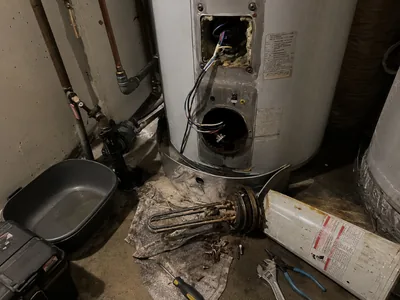
How we replace a water heater element
Check the fault before replacing parts
Before dismantling, Tallinn Torutööd measures the resistance of the old heater, because a faulty thermostat also gives the same symptoms. Only the part that is faulty during the measurement is billed: in the case of a thermostat failure, the customer pays for the thermostat and its replacement, and the heating element is not billed.
Drain and clean the tank
We shut off the cold water supply, open a hot tap and drain the tank through a hose into the toilet. This takes 10 minutes for a 100-litre water heater. We then remove the flange cover and clear the scale from the bottom of the tank; four litres can build up over six years.
Fit the new element and anode
We fit each new heating element with a new flange gasket and tighten the bolts in a cross pattern to avoid leaks. We also remove the magnesium anode and show the customer its condition. The tank is filled and vented before power is restored, because an element switched on dry can burn out in seconds.
Call now:
- Open every day
- Licensed and insured
- 100% satisfaction guarantee
Water heaters in narrow apartment bathrooms
In Lasnamäe and Mustamäe apartment buildings, the boiler is located in the toilet above the door, where there is 40 cm of space to pull out the flange cover. Tallinn Torutööd also keeps heating elements with shortened stems in the van, which can fit in such a space without removing the boiler from the wall, and covers the toilet floor with an absorbent tarp while emptying. In 2025, the heating element with a shortened stem went into 73 water heaters above toilets in Lasnamäe and Mustamäe.
Heating element replacement prices and times
Water heater element replacement starts at €77, thermostat replacement at €50, and fitting a new magnesium anode during the same visit adds €25. Element replacement takes 45 minutes: 10 to drain the tank, 20 to replace the element and clean the tank, and 15 to refill it and check for leaks. The call-out fee within Tallinn is €7.40. In 2025, Tallinn Torutööd replaced 207 elements, including 188 replaced by Oskar Kurg.
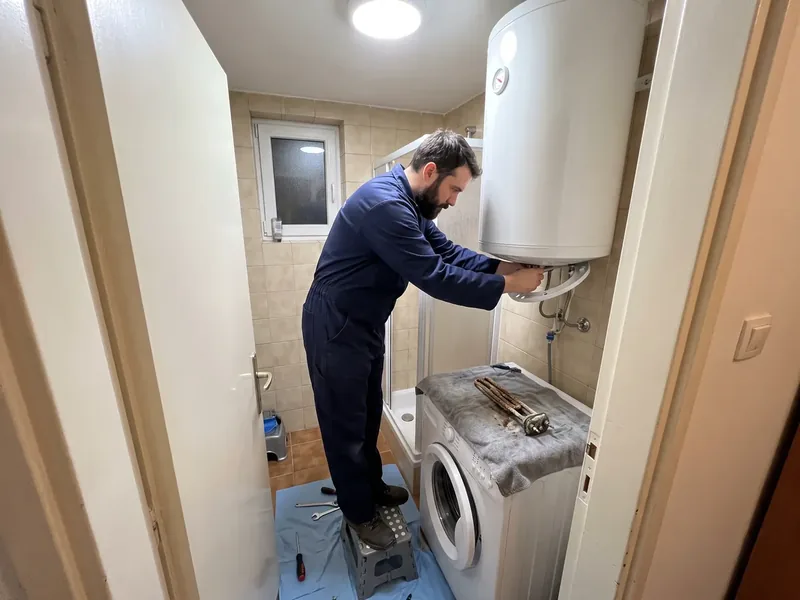
water heater element Replacement in Väike-Õismäe Apartment Near Tallinn Õismäe Gymnasium
Customer: Karin S., apartment owner in Väike-Õismäe, whose boiler tripped the residual current device. property: Near Tallinn Õismäe High School, Väike-Õismäe.
1. Confirmation of the fault before the replacement: the residual current device was switched off immediately when the boiler was switched on, the resistance of the 2000-watt element was 26 ohms and the insulation resistance against the tank was only 2000 ohms, the thermostat was found to be healthy when measured and only the heating element was replaced.
2. Emptying and cleaning the tank: The 80-liter tank was emptied into the bathtub with a hose, and 4 liters of scale came out of the bottom of the 6-year-old boiler.
3. Installation of a new heating element and anode: the boiler manufacturer provides a ceramic protective sleeve, so the wet heating element was replaced by a dry heating element with a new flange gasket, the bolts were tightened crosswise and the 14 mm magnesium anode remained.
4. Filling and leakage control: the element only turned on when the tank was filled and aerated, the joints remained dry and the residual current protection remained inside even in 60-degree water.
Invoice: Heater replacement, 1 × €77; price difference between a dry heating element and a wet heating element, 1 × €40; call-out within Tallinn, 1 × €7.40. Total €124.40 including VAT.
Working time: 45 minutes including emptying the tank, cleaning the bottom, filling and checking for leaks (2026, handover report no. 55873).
Result: With the new dry heating element, the boiler keeps the water at 60 degrees and the next element change takes place without emptying the 80-liter tank.
Frequently asked questions
Should I choose a wet or dry heating element?
The wet heating element is in direct contact with water and is cheaper, and scale settles directly on its surface. The dry heating element is located in a ceramic protective sleeve, lasts longer in hard water and can be replaced later without emptying the tank. The dry heating element only goes into the boiler, which the manufacturer has provided a sleeve, and the price difference is 40 euros.
Should I replace the element or buy a new water heater?
For a boiler less than 10 years old, the tank of which does not leak, the replacement of the heating element from 77 euros is clearly cheaper than a new device, the installation of which on the wall costs from 110 euros, plus the price of the boiler itself. A new heating element will not help a leaky tank, because the weld of the tank will not be repaired on site.
Does a lower temperature reduce limescale?
Yes. Keeping the thermostat at 60 degrees instead of 75 slows scale formation because calcium carbonate precipitates faster than hotter water, and keeps the water hot enough to prevent legionella from multiplying in the tank.
How long will a new element last?
A new wet heating element lasts 6 years in hard water, and maintenance extends it: cleaning the boiler from scale every 2 years and replacing the anode worn less than 10 mm will keep the element and tank in working order longer. A dry heating element will last longer in the same water because the scale accumulates on the sleeve, not the element.